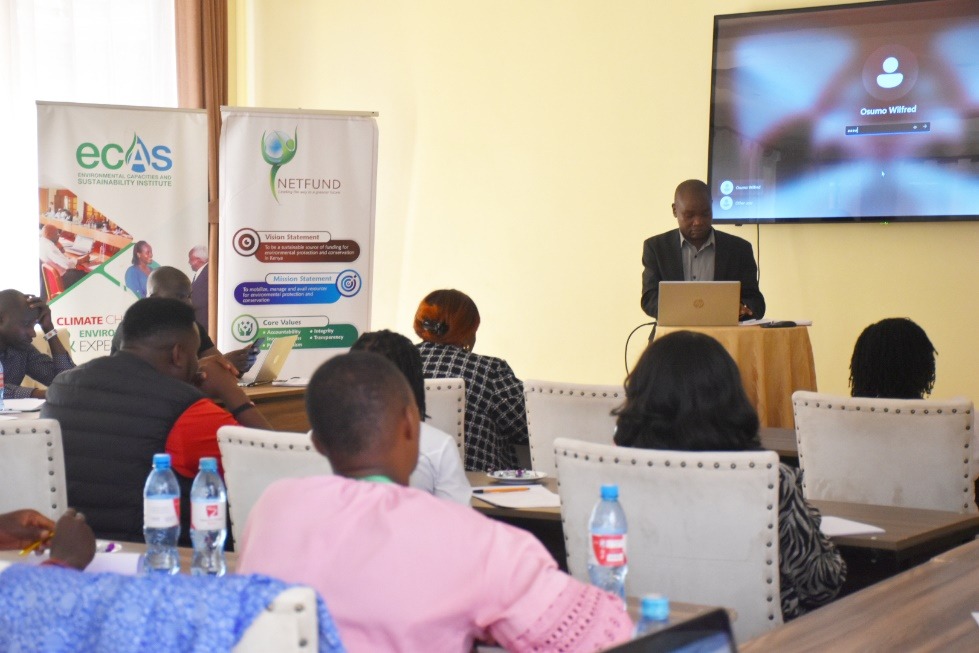
Big Data, AI & Machine Learning, Climate Modeling & Deep Learning
Big Data in Environmental Applications
Course Background
The digital age has led to an explosion of environmental data from satellites, sensors, citizen science, and climate models. ECAS Institute’s introductory course provides foundational knowledge on Big Data concepts, tools, and applications in environmental science.
Objectives
Define Big Data and its 5 Vs within an environmental context.
Identify common sources of environmental Big Data.
Understand challenges and opportunities in environmental data analysis.
Gain familiarity with Big Data processing and storage architectures.
Recognize entry-level tools for data exploration and visualization.
Modules
No
Module
Details
1
Introduction to Big Data: The 5 Vs
Definition, characteristics, relevance, and ecosystem overview.
Data quality, storage, governance, privacy, real-time monitoring, predictive modeling, case studies.
4
Big Data Processing & Storage
Distributed computing, cloud concepts, data lakes, data warehouses, relevant formats.
5
Big Data Analytics & Tools
Overview of analytics, machine learning concepts, Hadoop/Spark, visualization tools.
6
Case Studies & Future Trends
Climate change, biodiversity, smart cities, AI integration, ethical considerations.
Artificial Intelligence (AI) & Machine Learning (ML) in Environmental Science
Course Background
AI and ML are revolutionizing environmental science by enabling predictive modeling, pattern recognition, and data-driven decision-making. This course bridges theory and practical application in environmental datasets.
Objectives
Understand AI/ML fundamentals and relevance to environment.
Apply supervised, unsupervised, and deep learning algorithms.
Use AI/ML tools for prediction, classification, and feature engineering.
Evaluate model performance and interpret outputs.
Explore real-world environmental applications and ethical considerations.
Modules
No
Module
Details
1
Introduction to AI, ML & Environmental Data
Definitions, workflow, datasets, and importance of AI/ML.
2
Supervised Learning
Regression, classification, key algorithms.
3
Unsupervised Learning & Beyond
Clustering, dimensionality reduction, ensemble methods, intro to deep learning.
4
Data Preprocessing & Feature Engineering
Data cleaning, transformation, geospatial processing.
Bias, privacy, accountability, AI for SDGs, emerging trends.
Machine Learning for Climate Modeling and Prediction
Course Background
Machine Learning provides cutting-edge tools to analyze complex climate datasets and enhance predictions. This course equips professionals with practical ML skills to improve climate models and forecast extreme events.
Objectives
Understand ML concepts relevant to climate science.
Apply supervised and unsupervised learning to climate datasets.
Use deep learning models for complex climate phenomena.
Evaluate strengths and limitations of ML in climate modeling.
Develop predictive models for extreme events and climate trends.
Modules
No
Module
Details
1
Introduction to ML for Climate Science
AI/ML overview, challenges, paradigms.
2
Data Preprocessing & EDA
Climate data sources, cleaning, normalization, exploratory analysis.
This course equips professionals with deep learning skills to analyze complex environmental image datasets, using CNNs for classification, object detection, and segmentation, with applications in biodiversity, climate, and land-use monitoring.
Objectives
Understand deep learning concepts, particularly CNNs for image analysis.
Identify various types of environmental image data.
Implement full DL workflow: preparation, modeling, deployment.
Apply CNNs for classification, object detection, and segmentation.
Evaluate DL model performance with appropriate metrics.
Use frameworks like TensorFlow, Keras, and PyTorch.
Apply DL to real-world environmental problems.
Modules
No
Module
Details
1
Introduction to DL for Image Analysis
AI, ML & DL recap, neural networks, environmental image sources.
Payment should be sent to our bank account before the training start date, with proof of payment sent to the same email.
About ECAS Institute
ECAS Institute delivers independent training, research, and consulting services focused on climate change, renewable energy, biodiversity conservation, agriculture, and food systems. Based in Nairobi, Kenya, ECAS operates across Africa and globally, partnering with organizations in the UK, Denmark, Italy, Sweden, Germany, and the USA.
International Training on Management of Environment and Energy Projects Concept Note Course Background The Management of Environment and Energy Projects
International Training on Investment Management ECAS Institute offers this comprehensive Investment Management training to equip professionals with the knowledge, analytical
International Training on Business Ethics and Corporate Social Responsibility (CSR) ECAS Institute presents an intensive international training program designed to