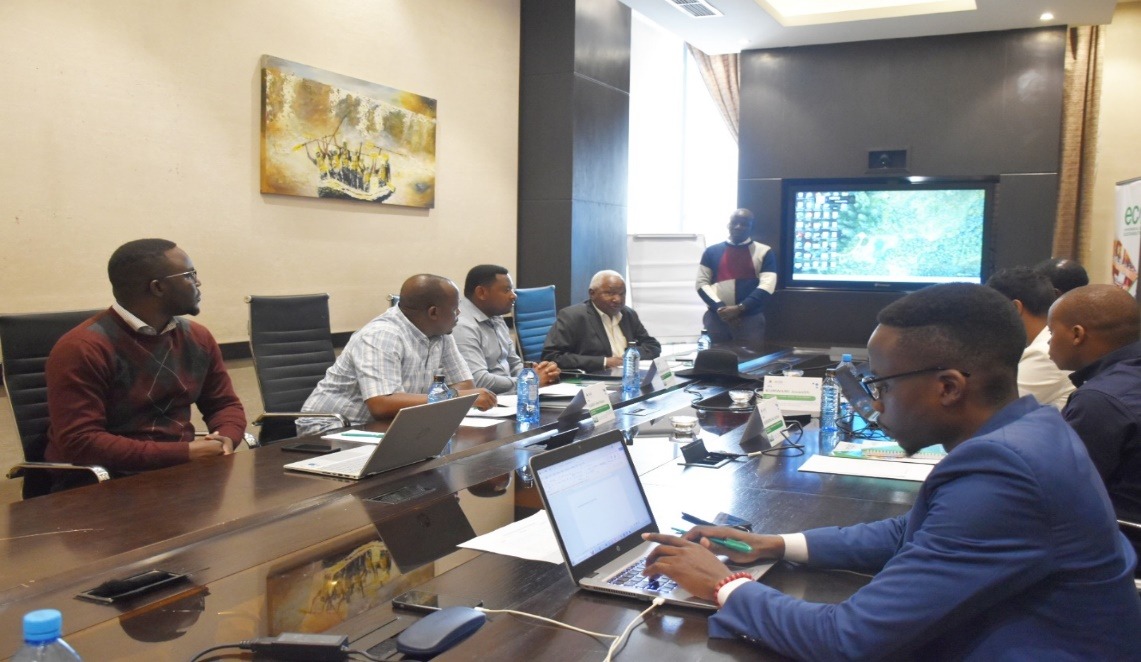
International Training on Big Data in Environmental Applications (Introduction)
BackgroundObjectivesWhat You Will LearnModulesParticipantsContactCourse Background
The digital age has generated unprecedented environmental data—from satellite imagery and sensor networks to climate simulations and citizen science initiatives. This Big Data presents both challenges and opportunities for environmental research and management.
ECAS Institute offers this introductory course to provide foundational knowledge of Big Data, its tools, techniques, and applications in environmental monitoring, research, and sustainable development.
Course Objectives
Define Big Data and describe its 5 Vs (Volume, Velocity, Variety, Veracity, Value) in environmental contexts.Identify common environmental Big Data sources (e.g., satellites, sensors, social media).Understand challenges and opportunities in managing and analyzing environmental Big Data.Differentiating structured, semi-structured, and unstructured environmental data.Gain familiarity with Big Data processing and storage architectures.Recognize entry-level tools and platforms for exploring and visualizing Big Data.Articulate real-world examples of Big Data solving environmental problems.What You Will Learn
Understand the principles of Big Data and why traditional methods fall short for environmental challenges.Identify sources of Big Data in monitoring, research, and policy-making.Appreciate the potential of Big Data in environmental prediction, resource management, and conservation.Recognize the components of a Big Data ecosystem: ingestion, storage, processing, analysis.Explore basic analytical techniques and software paradigms for large environmental datasets.See practical examples of Big Data applications in climate, biodiversity, and resource management.Build foundational vocabulary to engage in discussions on Big Data and environmental technology.Target Participants
Environmental scientists and researchers new to Big Data.Environmental managers, consultants, and policymakers.Students in environmental studies, geography, or related fields.IT professionals interested in environmental Big Data applications.Anyone exploring the intersection of data technology and environmental sustainability.Training Modules
| No | Module | Details |
|---|
| 1 | Introduction to Big Data: The 5 Vs and Beyond | Definition, evolution, 5 Vs, relevance to environmental challenges, overview of Big Data ecosystem. |
| 2 | Sources of Environmental Big Data | Remote sensing, sensor networks, GIS, citizen science, social media, climate models, open data portals. |
| 3 | Challenges and Opportunities of Big Data in Environment | Data quality, storage, processing, governance, ethics; opportunities in monitoring, modeling, policy evaluation; case studies. |
| 4 | Basic Concepts of Big Data Processing & Storage | Distributed computing, cloud computing, data lakes/warehouses, relevant data formats (NetCDF, HDF5, JSON, Parquet). |
| 5 | Introduction to Big Data Analytics and Tools | Analytics techniques (descriptive, predictive, prescriptive), machine learning concepts, Big Data tools overview, visualization tools. |
| 6 | Case Studies and Future Trends | Applications in climate change, biodiversity conservation, smart cities, AI in environmental Big Data, ethical considerations. |
Contact & Registration
For registration or tailor-made courses, contact: info@ecasiafrica.org
Payment should be sent to our bank account before the training start date, with proof of payment sent to the same email.
About ECAS Institute
ECAS Institute delivers independent training, research, and consulting services focusing on climate change, renewable energy, biodiversity conservation, agriculture, and food systems. Based in Nairobi, Kenya, ECAS operates across Africa and globally, partnering with organizations from the UK, Denmark, Italy, Sweden, Germany, and the USA.